May 22, 2026
Your mind and spirit is the strongest weapon you have
Let’s talk about Apex Legends, a free online team-based first-person battle royale game that has given me countless hours of enjoyment.
It’s interesting how a game (like so many others) where we simulate skirmishes and armed conflict can be so entertaining even for those of us who reject violence and weapons in real life.
War culture has been part of our collective imagination for as long as we can remember. Many of us who grew up during the 80s and 90s were surrounded by movies starring Stallone or Schwarzenegger, with franchises like Rambo, Top Gun or Universal Soldier, cartoons such as G.I. Joe, invincible superheroes and videogames where conflict was constantly romanticized.
Without even realizing it, we ended up playing “commandos” in empty lots, parks or unfinished buildings: invisible guns, “I got you!”, “No you didn’t, I dodged it!”. And I think that, for better or worse, part of that seed is still present today whenever we enjoy this kind of videogame.
For those of us who lived through the birth of multiplayer FPS games with titles like Quake III Arena or Unreal Tournament, Apex Legends feels in many ways like a dream come true. Asymmetrical yet balanced characters, fast-paced matches, a brilliant communication system, smooth and satisfying movement, exploration, intense combat and a very successful blend of realism and fantasy.
Apex Legends leaves no one indifferent. It may not be the easiest battle royale to get into, but once everything clicks, it becomes an incredibly fun experience. I also believe it encourages interesting skills such as communication, quick decision-making, time management and spatial awareness.
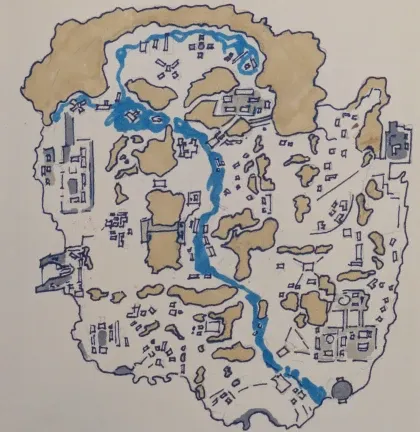
Kings Canyon was the game’s very first map.
Let’s analyze the different pieces that make up Apex Legends.
Before becoming one of the most popular battle royale games, Apex Legends started as a spin-off set within the Titanfall universe.
Even though Apex Legends left behind Titanfall’s iconic pilotable titans, it still retains a large part of its gameplay identity.
Apex Legends uses a heavily modified version of the Source engine, originally created by Valve in 2004.
Respawn Entertainment took the branch developed for Titanfall as a foundation and progressively evolved it until it became something very close to a proprietary engine, now far removed from the classic Source version.
Today, this branch of Source continues evolving exclusively for Apex Legends. For more information, take a look at the Valve developer community page.
Apex Legends offers quite a few different ways to play.
Even though Apex Legends includes multiple game modes, the core experience is still the classic battle royale.
Our objective is simple: be the last squad standing.
How do we achieve that?
Based on my experience, this is the typical flow of a match:
From there, the cycle repeats itself until we are eliminated or win the match.
Apex Legends weapons can be classified in two different ways:
By category: assault rifles, SMGs, light machine guns, marksman weapons, sniper rifles, shotguns and pistols
By ammo type: light, heavy, energy, shotgun, sniper, arrows and mythic
We can only carry two weapons simultaneously (with exceptions such as Ballistic, who can carry a third one).
From there, each player’s personal playstyle comes into play:
These changes mainly respond to balancing and gameplay variety considerations.
The current 28 legends are divided into five major classes, each one providing specific advantages that add more tactical depth to the game:
Assault
Skirmisher
Recon
Support
Controller
As you can see, the introduction of new legends has gradually slowed down over time. This makes perfect sense considering how difficult it must be to balance so many different abilities and synergies.
Looting is one of the fundamental pillars of Apex Legends.
We need to quickly obtain solid equipment in order to survive the fights that will inevitably happen throughout the match.
Items can be obtained in several ways:
Items come in different rarity tiers (distinguished by color and iconography): common, rare, epic, legendary, mythic.
The higher the rarity, the better the advantages and performance.
Combat is the core of the game. Winning a match without fighting other squads is extremely unlikely.
To eliminate an enemy we must:
While a player is downed they can still:
Our shield progressively evolves during the match, becoming stronger through EVO points earned in different ways:
Health and shields can be restored using consumables or specific legend abilities.
If one of our teammates gets eliminated, there are still several ways to bring them back into the match.
During the early seasons, reviving teammates was much more difficult, which caused many players to leave matches prematurely.
Over time, several solutions were added to improve this:
Respawns now return players with the weapons they had when they were eliminated, as long as nobody looted them beforehand. In earlier seasons, players respawned completely unarmed, making survival extremely difficult.
All these changes have made matches far more dynamic and less frustrating.
As in any battle royale, constant movement is essential.
The map progressively shrinks through the ring, a safe zone that continuously forces squads to reposition.
Staying outside the ring causes constant damage until death, making rotations and route control just as important as raw combat skill.
All these pieces come together to form a highly enjoyable experience.
In the end, Apex Legends feels like much more than a simple shooter. It works as a tactical system where information, space and timing are just as important as aim itself.

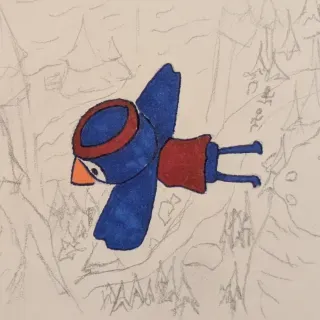
Axle sketch from Season 29.
Apex Legends shares more similarities with board games than it might initially seem. While thinking about this analysis, I constantly found myself drawing parallels with mechanics and sensations commonly found in tabletop game design. Let’s look at a few examples.
As of Season 29, Apex Legends features 28 different legends, each with their own abilities. This allows for countless combinations and team synergies.
In the board game world, clear examples can be found in games such as Unmatched or Gloomhaven, where asymmetrical characters and tactical cooperation are essential parts of the experience.
In Apex Legends, as in other battle royale games, the map progressively shrinks until players are forced into confrontation.
Blood Rage implements a very similar concept through Ragnarök, destroying regions of the board each era and gradually reducing the safe playable space.
In both cases, the design forces players out of comfortable positions while maintaining constant tension throughout the game.
In Apex Legends, we can never fully relax. While fighting one squad, another may appear at any moment, attracted by noise or movement.
That feeling strongly reminds me of games like Nemesis or Specter Ops, where noise mechanics and uncertainty turn every confrontation into a potentially disastrous situation.
Looting in Apex Legends involves a lot of instant resource management. We constantly decide whether to keep a weapon, swap attachments, save ammo or free up space for something better.
These rapid decisions resemble games such as Galaxy Trucker, where players must select and reorganize components under pressure and within limited time.
One of the most interesting systems introduced in recent seasons is the Arsenal Stations mechanic.
These stations always appear in fixed locations across the map and contain weapons and ammo from a randomly selected category. They also allow players to upgrade those weapons once per station.
What makes them especially interesting is how they transform loot into a kind of “spatial economy”: the map stops being just a backdrop and starts defining routes, hotspots and strategic decisions.
Similar ideas can be found in board games such as Scythe, where each region produces specific resources and positioning directly shapes our strategy.
As strange as it may sound, Apex Legends shares certain sensations with many modern eurogames.
Just like in games such as Brass or El Grande, success here also depends on mastering aspects like:
It’s fascinating how such a frantic FPS can share so many design ideas with fundamentally strategic board games.
In fact, Apex Legends even has its own tabletop adaptation, although I still haven’t had the chance to try it.
The match progression.
The beginning of a match can vary wildly:
🙈 Terrible failure: dying before even getting equipped
🫠 Standard failure: basic loot and quick defeat
🐔 Coward mode: landing in a crowded area and running away as far as possible
🍀 Extreme luck: surviving the first fight and taking all the loot
💆 Calm beginning: landing far away and gearing up peacefully
If we survive the first few minutes, the sense of progression becomes fantastic:
There is no pay-to-win.
Apex Legends deserves a lot of respect for offering so many hours of content completely free and without gameplay advantages for paying players.
I like how the game allows small gestures of courtesy within the team, such as saying thank you or responding “you’re welcome”.
The freedom of movement is absolutely incredible:
There are basic movement techniques, but also advanced mechanics the community itself has gradually discovered over time.
Teamwork matters, but it’s not overwhelmingly restrictive.
Unlike games such as Overwatch, a single player can still make a huge difference during a match.
The enormous variety of characters and abilities.
The possible combinations between legends generate countless strategies and playstyles.
The game has never stopped evolving since 2019.
Over the years we’ve seen:
All of this helps the game still feel fresh even after so many years.
The ping communication system.
It’s probably one of my favorite mechanics in the entire game. Simply by pinging elements in the environment we can communicate efficiently without using voice chat.
The artistic design of the legends.
The character models, animations and skins all have tremendous quality and personality.
I never became especially interested in the characters’ narrative and lore.
It’s a shame because I usually enjoy this kind of storytelling in videogames.
The loot box system feels unsatisfying to me.
I would much rather unlock most cosmetic items through achievements and gameplay challenges.
Some menus and interface systems have become overly complex over time.
Especially those related to battle passes, heirlooms and premium cosmetics.
The game is addictive…maybe a little too much.
As happens with many free-to-play games, the ease of jumping from one match straight into another can make you completely lose track of time…although, as can be seen in this Reddit thread, it apparently helped someone quit smoking.